Sapling-NeRF: Geo-Localised Sapling Reconstruction in Forests for Ecological Monitoring
Miguel Ángel Muñoz-Bañón, Nived Chebrolu, Sruthi M. Krishna Moorthy, Yifu Tao, Fernando Torres, Roberto Salguero-Gómez, Maurice Fallon



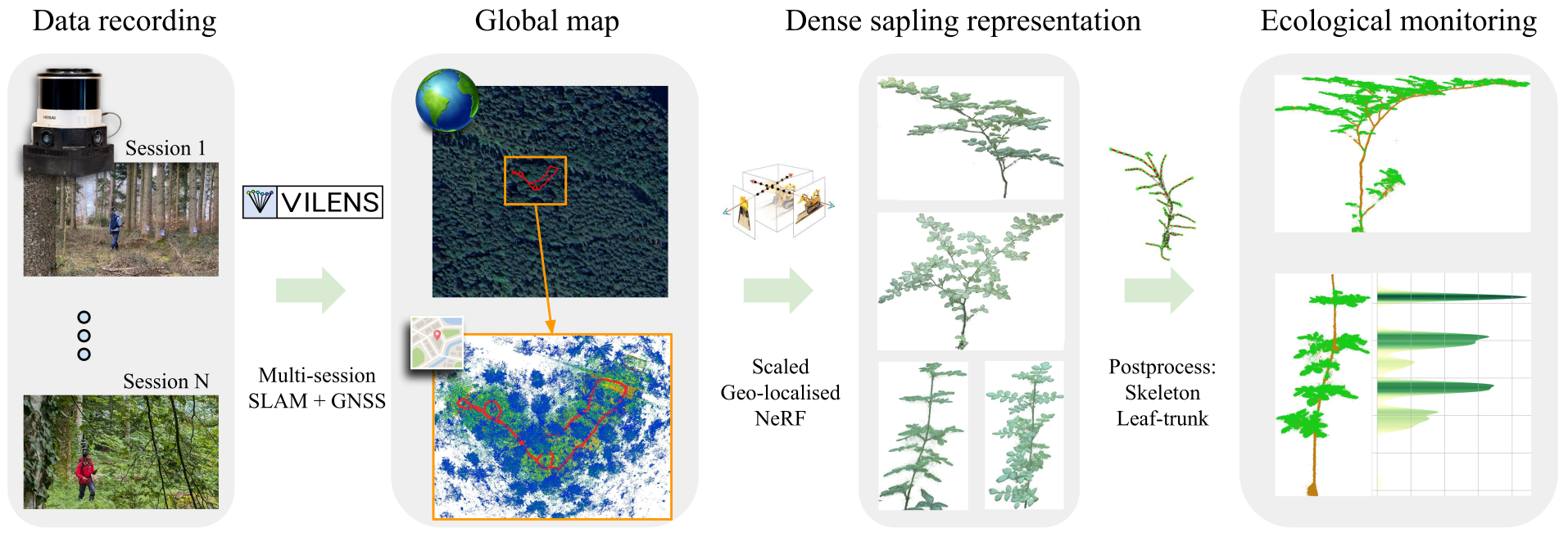
Joint NeRF and LiDAR SLAM system for sapling reconstruction in situ in the forest:
- Global Map: LiDAR SLAM system with hectare-scale multi-session map and GNSS alignment.
- Dense Sapling Representation: The images and poses are then used to train NeRF models for each sapling (with metric scale and global localisation).
- Ecological Monitoring: The NeRF-derived point cloud is sufficiently accurate to detect the tree skeleton and to measure leaf-wood separation and the leaf distribution over time.
Abstract Saplings are key indicators of forest regeneration and overall forest health. However, their fine-scale architectural traits are difficult to capture with existing 3D sensing methods, which make quantitative evaluation difficult. Terrestrial Laser Scanners (TLS), Mobile Laser Scanners (MLS), or traditional photogrammetry approaches poorly reconstruct thin branches, dense foliage, and lack the scale consistency needed for long-term monitoring. Implicit 3D reconstruction methods such as Neural Radiance Fields (NeRF) and 3D Gaussian Splatting (3DGS) are promising alternatives, but cannot recover the true scale of a scene and lack any means to be accurately geo-localised. In this paper, we present a pipeline which fuses NeRF, LiDAR SLAM, and GNSS to enable repeatable, geo-localised ecological monitoring of saplings. Our system proposes a three-level representation: (i) coarse Earth-frame localisation using GNSS, (ii) LiDAR-based SLAM for centimetre-accurate localisation and reconstruction, and (iii) NeRF-derived object-centric dense reconstruction of individual saplings. This approach enables repeatable quantitative evaluation and long-term monitoring of sapling traits. Our experiments in forest plots in Wytham Woods (Oxford, UK) and Evo (Finland) show that stem height, branching patterns, and leaf-to-wood ratios can be captured with increased accuracy as compared to TLS. We demonstrate that accurate stem skeletons and leaf distributions can be measured for saplings with heights between 0.5m and 2m in situ, giving ecologists access to richer structural and quantitative data for analysing forest dynamics.
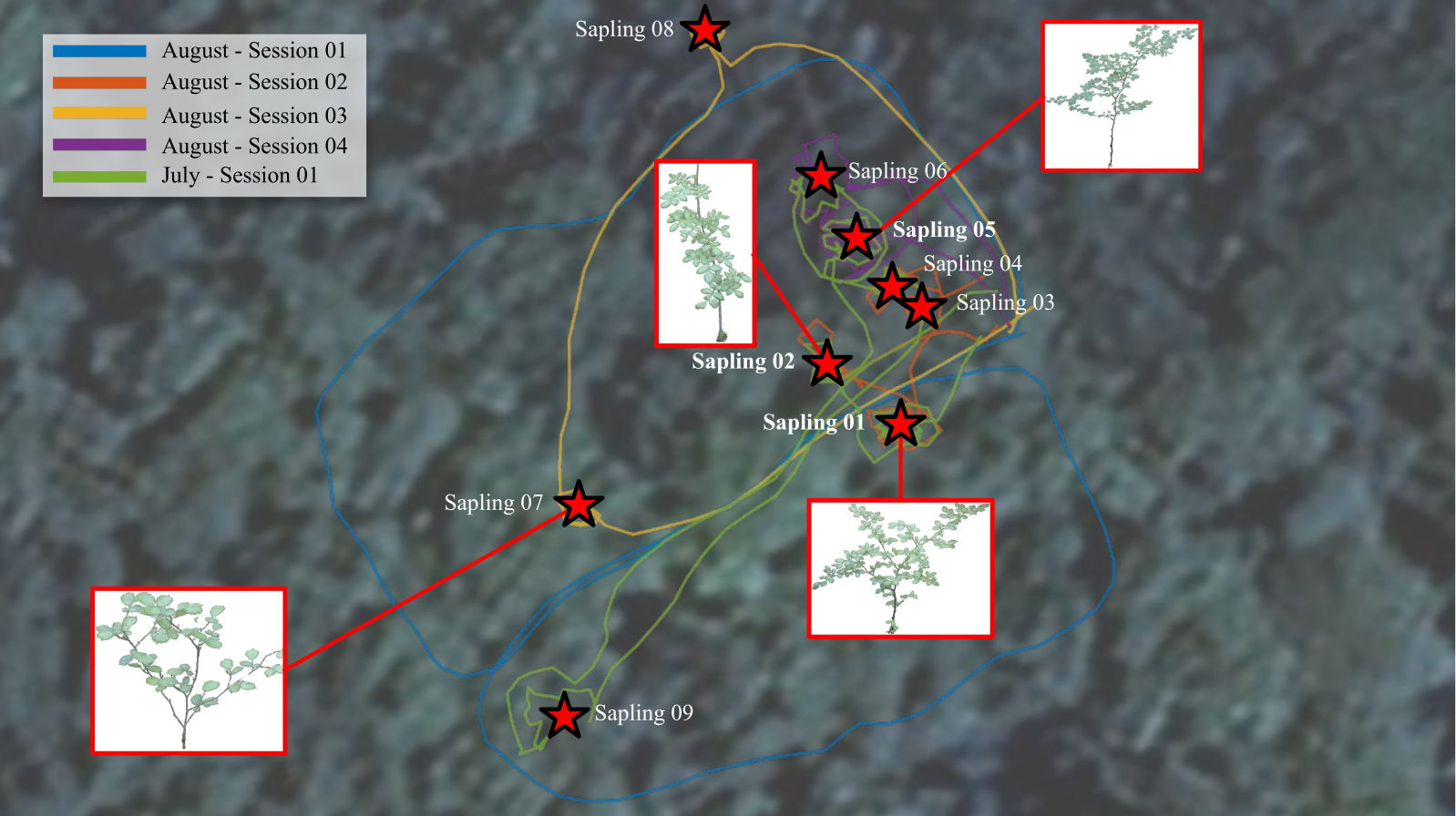
Geo-localisation
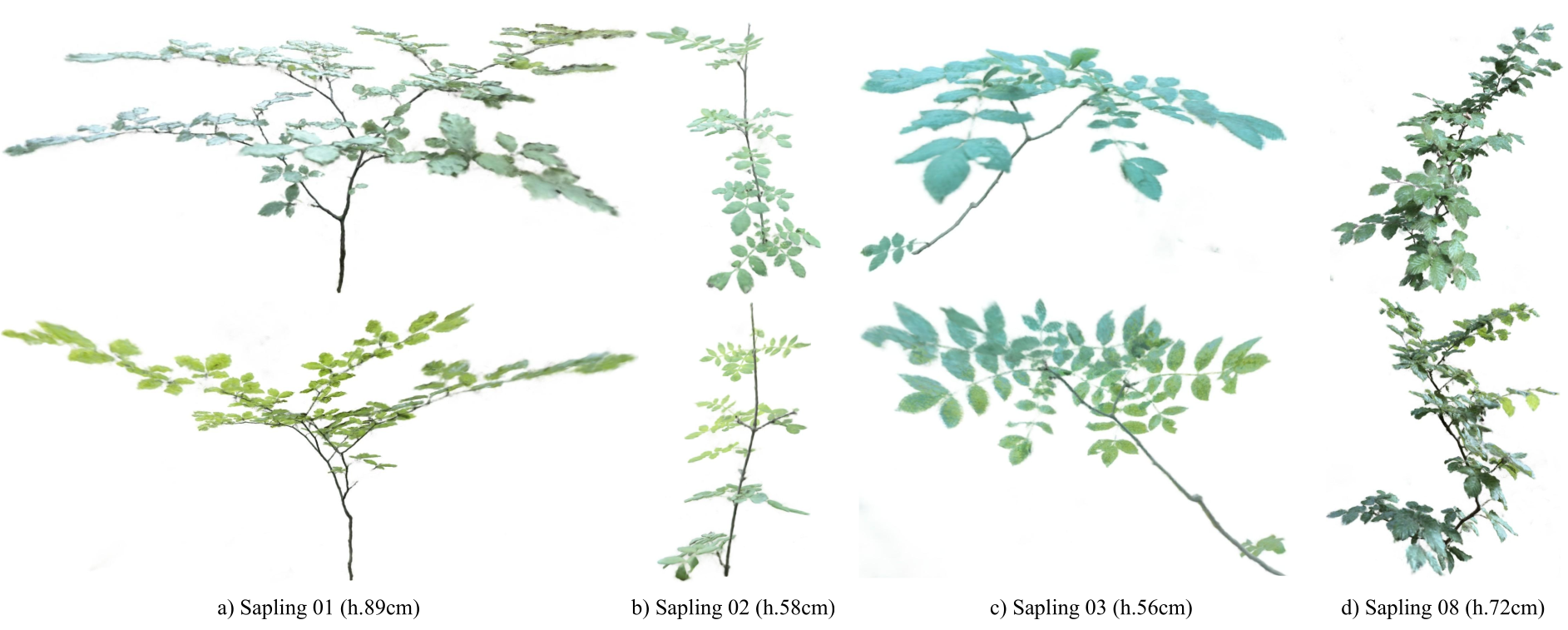
Novel-View synthesis
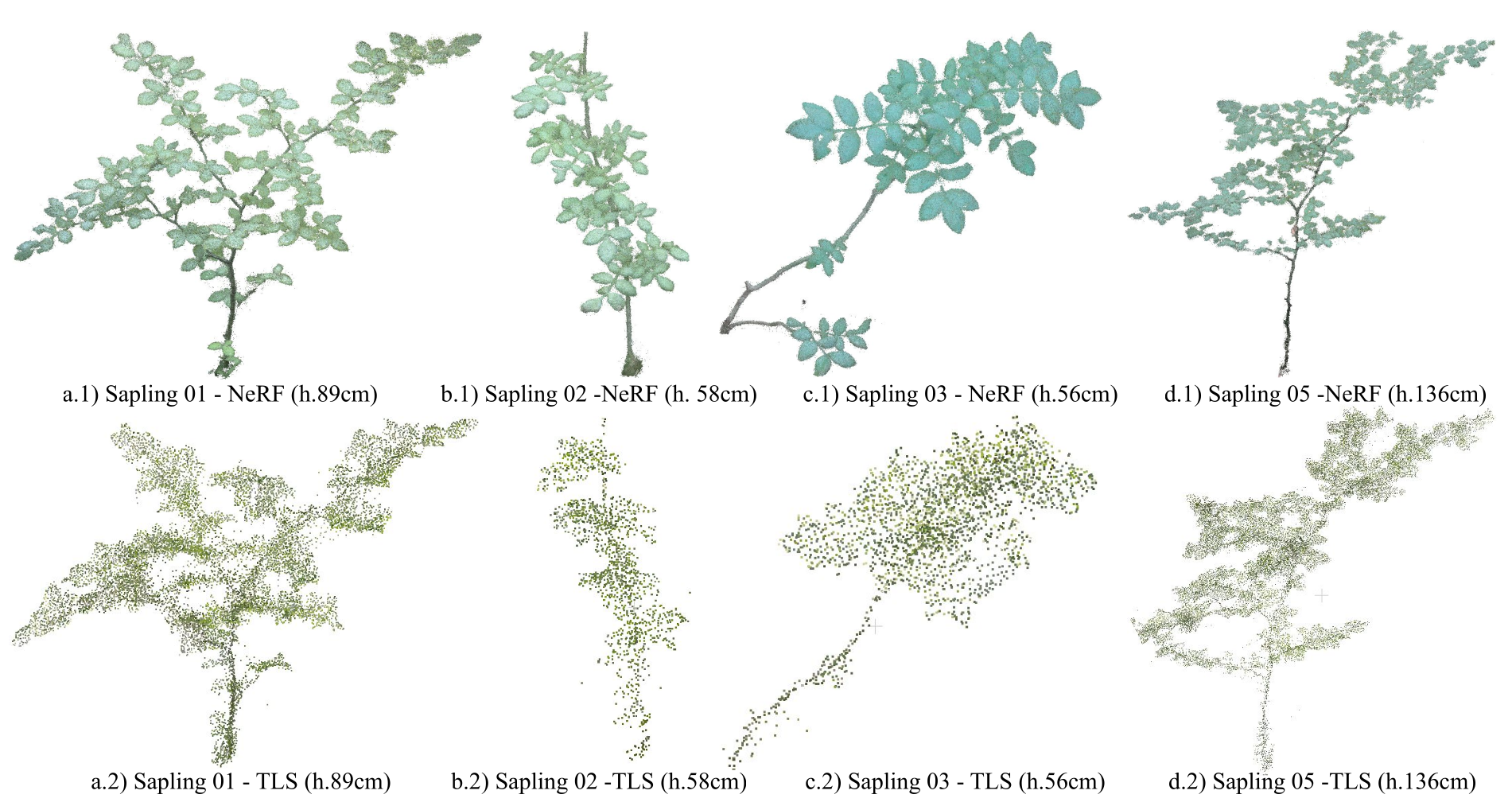
NeRF vs TLS comparison
Citation
@article{munoz2026sapling,
  title={Sapling-NeRF: Geo-Localised Sapling Reconstruction in Forests for Ecological Monitoring},
  author={Mu{\~n}oz-Ba{\~n}{\'o}n, Miguel {\'A}ngel and Chebrolu, Nived and Moorthy, Sruthi M Krishna and Tao, Yifu and Torres, Fernando and Salguero-G{\'o}mez, Roberto and Fallon, Maurice},
  journal={arXiv preprint arXiv:2602.22731},
  year={2026}
}